Tuesday, 28 April 2009

'Four in 10 Britons could fall ill in flu pandemic'

Press Association

Professor Neil Ferguson, a member of the World Health Organisation (WHO) taskforce which decided to raise its alert over the virus to level four last night, said four in 10 people could be infected if the country is hit by a pandemic.

Gordon Brown pledged today that the Government would take "all the urgent action that is necessary" to halt the spread of swine flu.

Speaking in the Polish capital, Warsaw, the Prime Minister insisted that Britain was well-prepared to deal with a major flu outbreak.

He said he would be taking part in a meeting of the Government's Cobra emergencies committee being chaired by Health Secretary Alan Johnson later today.

"We have been preparing for this kind of scenario for many years. Britain is among the best prepared countries in the world," he said.

Earlier, Britons were warned to avoid all but essential travel to Mexico as the WHO said the deadly swine flu virus can no longer be contained and raised its alert to two lower than the maximum of six, signifying a "significant increase in risk of a pandemic".

Prof Ferguson, of Imperial College, London, said cases were likely to die down within a matter of weeks because the UK was moving out of the normal season for flu infection, but may flare up again once the summer was over.

He told the BBC Radio 4 Today programme: "We don't really know what size epidemic we will get over the next couple of months. It is almost certain that, even if it does fade away in the next few weeks - which it might - we will get a seasonal epidemic in the autumn.

"We might expect up to 30 per cent-40 per cent of the population to become ill in the next six months if this truly turns into a pandemic."

The first two British cases were confirmed yesterday and more suspected infections emerged last night.

The Foreign Office said: "We are now advising against all but essential travel to Mexico."

It added that British nationals "resident in or visiting Mexico may wish to consider whether they should remain in Mexico at this time".

The two confirmed patients, Iain and Dawn Askham, of Polmont, near Falkirk, had been on honeymoon in Mexico and were being treated today in isolation at Monklands Hospital in Airdrie, Lanarkshire.

Scottish Health Secretary Nicola Sturgeon said they had tested positive and seven of 22 people who had been in "close contact" with the couple were showing "mild symptoms".

She told BBC Radio Scotland these including workmates and added: "We remain very vigilant."

"At the moment we have no evidence that the virus is in the wider community, although people will understand I obviously can't rule that out," she said.

"I would say in terms of reassurance that the one thing everyone in the international community is taking encouragement from is that, outside of Mexico, everybody contracting this virus is displaying very mild symptoms."

She added that the two infected individuals were responding well to anti-viral drugs.

Travel firms Thomson Holidays and First Choice said they had decided to repatriate their customers from Mexico and to cancel flights bound for Cancun from Gatwick and Manchester today.

Thomson said: "While we do appreciate that the new news may be a great disappointment to customers, we hope they will also understand that their health and safety is of paramount importance to us."

It added that flights due to operate to Mexico from tomorrow onwards were under discussion and decisions would be made later today.

So far 152 people are thought to have been killed in Mexico by the virus, which is caused when the H1N1 strain associated with pigs crosses over to the human population.

Outbreaks have also been confirmed in the United States, Canada and Spain.

Suspected cases from New Zealand to Israel were raising concern that the new virus was spreading rapidly.

It was also confirmed that four people in the Republic of Ireland were being tested.

The Health Service Executive (HSE) in Dublin said the results of those tests were expected today.

A passenger on an incoming flight from Mexico was treated by medics at Manchester Airport this morning, but later sent home, the Health Protection Agency said.

WHO's assistant director-general, Keiji Fukuda, said "at this time containment is not a feasible option" as the virus has already spread to several other countries.

He added: "At this time, instituting travel bans would really not be very effective as the virus has already spread to several other countries."

Commenting on the raising of the WHO's alert level to four, he said: "What this can really be interpreted as is a significant step towards pandemic influenza. But also, it is a phase that says we are not there yet.

"In other words, at this time we think we have taken a step in that direction, but a pandemic is not considered inevitable."

Professor Sir Liam Donaldson, the Government's Chief Medical Adviser, said: "The WHO has changed the alert to stage four. This means there are small clusters of outbreaks with limited person-to-person transmission.

"From some affected areas, it appears that early doses of anti-virals such as Tamiflu are helping people to recover."

He said there were enough anti-virals to treat "half the population" if they became ill.

"We have been preparing for the possibility for a number of years and are among the most prepared countries in the world," he said.

Dr Maureen Baker, the honorary secretary of the Royal College of GPs, said family doctors should reassure patients that they can expect to recover from flu within a week - even if it is swine flu.

Dr Baker told the BBC Radio 4 Today programme: "GPs should be saying to people not to panic, that we are well prepared and that most people who get ill with flu will have a nasty bout of flu and get better within a week, even if it is swine flu."

In the US, the number of cases rose to 50, the result of further testing at a New York City school, although none was fatal. Other US cases have been reported in Ohio, Kansas, Texas and California. Six cases were confirmed in Canada, a further one in Spain, three in New Zealand and one in Israel.

Mexican health secretary Jose Angel Cordova said the epidemic was entering an extremely dangerous phase, with the number of people infected mushrooming even as authorities were improving defences.

Swine flu: British tourists repatriated from Mexico as virus spreads

Iain and Dawn Askham: First British victims of swine flu are honeymoon couple
Iain and Dawn Askham from Polmont, near Falkirk, are still being treated in isolation but are said to be recovering well

Travel giant TUI, which owns Thomson and First Choice holidays, said it was suspending its services to the resort of Cancun and would begin flying back its 2,500 Britons currently in the country later today on scheduled flights.

Thomas Cook has cancelled all Thomas Cook and Airtours holidays to Mexico for the next seven days, resulting in the cancellation of five flights from Manchester and Gatwick. It is also making arrangements for any of its 3,000 customers in the country who want to come home early.

The operators acted after the Foreign Office warned against all but essential travel to Mexico, where more than 150 people are now thought to have died in the swine flu outbreak.

Possible cases of the virus are being reported across Britain today following the confirmation of its first UK-based victims - a married couple who last week returned from their honeymoon in Cancun.

NHS officials said that the virus may have spread to Wiltshire, with seven people suffering from flu-like symptoms currently undergoing tests to find out if they have the potentially lethal illness. Results were expected later today.

A "handful" of cases are also being investigated in Wales. Tony Jewell, the country's chief medical officer, said: "We should expect that there will be some confirmed cases in Wales at some point."

Reported cases are also being monitored in Derbyshire and Yorkshire.

World Health Organisation (WHO) experts are warning that the swine flu virus spreading around the world now cannot be contained, and could infect 40 per cent of the British population in the next six months if it becomes a pandemic.

Professor Neil Ferguson, of Imperial College, London said that the virus would likely return later in the year even if it died away in the next few weeks. "It is almost certain that... we will get a seasonal epidemic in the autumn," he said.

The WHO has raised its swine flu alert level to phase four on a scale that goes up to six, meaning the virus is now being passed between humans. The organisation's assistant-general Keiji Fukuda said this represented a "significant step towards pandemic influenza", although a pandemic was not yet inevitable.

"With the virus being widespread... closing borders or restricting travel really has very little effects in stopping the movement of this virus," he said.

Outside of Mexcio, swine flu has been confirmed in the US (44 cases), Canada (6) and New Zealand (3), with single cases in Israel and Spain. Dozens of other countries are investigating possible infections, with 70 sick people being tested in Australia alone. There are six reported cases in Ireland.

The first confirmed British sufferers were named this morning as Iain and Dawn Askham, a newly married couple from Falkirk, central Scotland.

Relatives of the couple say they are responding well to treatment in isolation, but 22 people who they came into contact with since landing back in the country are being kept under observation. Seven have shown mild flu-like symptoms

It is understood that Mr Askham, 27, first began to show symptoms last Thursday, on a night out with friends.

His wife also began to feel ill and they were admitted to the infectious diseases unit of Monklands Hospital in Airdrie on Saturday.

Mrs Askham is a healthcare assistant at Boots in Falkirk and her husband, a keen amateur footballer, is an information analyst for the utility company Scottish Power.

The couple were married at the Three Kings function suite in Falkirk three weeks ago. The Scottish Executive said they did not travel in the areas of Mexico most affected by swine flu.

Nicola Sturgeon, the Scottish health minister, said the couple were both doing well and were not particularly ill.

In the couple's home town of Polmont, near Falkirk, neighbours spoke of their shock.

Rachel Anderson, who lives across the road, said: "They were in Mexico for their honeymoon. On Saturday one of the neighbours noticed a paramedic on the street and they have not seen the couple since.

"It is a shame for them and I feel for their family. They will be very worried."

Britons who have pre-booked holidays to Mexico have been advised to check their insurance policies to see if they can claim the money back, although Thomas Cook and TUI have promised to do all they can to arrange alternative trips.

Stuart and Kelly Goddard, 25 and 24, from Coventry, were due to fly out this morning from Manchester Airport to Cancun for their honeymoon before finding out that their flight had been cancelled.

"We're absolutely gutted. We were married on Saturday and have been planning this for a year-and-a-half," Mr Goddard said.

Prime Minister Gordon Brown said today that the Government would take "all the action necessary" to prevent the spread of swine flu.

Speaking in the Polish capital, Warsaw, the Prime Minister insisted that Britain was well-prepared to deal with a major outbreak.

"We have been preparing for this kind of scenario for many years. Britain is among the best prepared countries in the world," he told a joint news conference with Polish Prime Minister Donald Tusk.

"We, together with the World Health Organisation and our partners in Europe and internationally, will continue to take all the urgent action that is necessary to halt the spread of this virus."

A pandemic is declared at level six. Since the alerts were introduced in 2005 it has never been higher than level three.

He said containing the disease was not feasible as it had already spread around the world.

Instead he said governments should concentrate on mitigation measures - giving people information on how to avoid catching the illness and being prepared to treat people who fall ill.

He also said there was no need to restrict travel between countries although anyone who is already ill should consult their doctor and stay at home, adding that closing borders would "cause a great deal of disruption for countries."

Fears were growing that the virus could cause a flu pandemic as a series of countries confirmed cases. Officials in Mexico – the centre of the outbreak – said there were 1,455 probable cases and 152 confirmed deaths.

In the Government's pandemic plan the worst case scenario suggests that if half the population contracted pandemic flu there could be around 709,000 deaths. Schools, sports events and concerts could be shut down to limit the spread of the illness.

Doctors who come into contact with suspected cases should wear face masks, gloves and aprons, under protocols issued by the Health Protection Agency. The WHO said the disease had ''pandemic potential'' but added that a pandemic was not "inevitable".

Monday, 27 April 2009

Mexico Swine flu a further hit to Mexican tourism

Swine flu a further hit to Mexican tourism

Mexico's tourism industry was suffering even before the current outbreak of swine flu

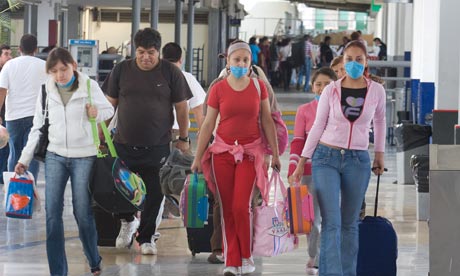
Traveller wearing masks due to the swine flu outbreak in Mexico

Travellers wearing masks due to the swine flu outbreak in Mexico. Photograph: KPA/Zuma/Rex Features

In Playa del Carmen, jewel of the Mayan Riviera and one of Mexico's hottest spots, the beach was already quiet and the hotels only half-full even a fortnight ago. The reason, explained my guide as we set off for a day at the Mayan ruins at Koba, was obvious: the economic slowdown is affecting the holiday industry the world over. But there was another reason, too, why the tourists were thinking twice before booking tickets to the international airport at Cancun: a few weeks ago President Felipe Calderon escalated his war on the drugs barons, and newspapers the world over have been full of reports on just how bloody that war is, with 8,000 people dead in the last two years.

So, my guide was already pessimistic about prospects for tourism in Mexico in 2009 - and that was before she'd ever heard of "la grippe porcine".

She's certainly heard of it now: more than 1,600 people in Mexico have been struck by swine flu, and 103 people are dead - and the figure is bound to rise. It's a tiny percentage of the population of Mexico - there are 23 million in Mexico City alone - but that's not the point. The point is that front-page photographs of people in surgical masks, praying to the Virgin of Guadalupe for deliverance from a terrifying disease sweeping through their community, is the very last thing Mexican tourism needed.

At the Mexico Tourist Board in London, staff were today fielding calls from worried would-be travellers wondering if they should cancel their holidays: more UK tourists have been travelling to Mexico in recent years (315,000, according to the latest figures), as an area put on the map by US and Canadian visitors has begun to open up to travellers from here, too. "What we've told callers," said Lupita Ayala, "is that Mexico City, where this outbreak is, is a long way from Cancun. People don't realise the geography of the place. They don't realise how great the distances involved are, and they're reassured by that."

Ayala certainly hopes she'll be able to spread reassurance - but with today's news that the EU health commissioner, Andorra Vassiliou, has cautioned against travel to Mexico for anything other than a "very urgent" reason, things aren't looking good. The tragedy for Mexico, a country economic analysts say could be particularly badly hit by the economic slowdown, is that tourism appeared to be one ray of hope, and last year was worth about US $13 billion to its coffers.

But perception of a country is the crucial ingredient in pulling in tourists, and the current image of Mexico on the world stage isn't healthy. Making things even worse is the fact that its capital city has the same name as the country, and many people don't distinguish between the two. The truth is that, just as the epicentre of the drugs war is hundreds of miles away from the azure waters of the Caribbean coastline on the US border, so the flu outbreak is a two-hour flight away from the seaside resorts, too. But for those about to book their 2009 holiday, that distinction may well be academic.

Four-year-old could hold key in search for source of swine flu outbreak

Case confirmed in village in east Mexico where sixty per cent of residents fell ill.
A Mexican village whose inhabitants were overwhelmed by an outbreak of respiratory illness starting in February has emerged as a possible source of the swine flu outbreak which has now spread across the world.

The state government of Veracruz in eastern Mexico has confirmed one case of swine flu in the village of La Gloria with the sufferer named locally as a four-year-old boy, Edgar Hernandez Hernandez. The federal government said tonight that he tested positive for the same strain of the virus which has claimed lives in Mexico.

The boy's case earlier this month came amid an outbreak of respiratory illness in the area in which around 400 people requested medical help. The boy was treated in hospital and survived. But two babies from the same village died during the outbreak. Sufferers complained of symptoms including fever, severe cough, and large amounts of phlegm.

"The symptoms were exactly like the ones they talk about now [with swine flu]," said a local resident. "High fevers, pain in the muscles and the joints, terrible headaches, some vomiting and diarrhoea. The illness came on very quickly and whole families were laid up."

It remained unclear tonight whether the illness was swine flu but the Mexican government appeared to cast doubt on its original diagnosis of the outbreak as a more typical H2N3 flu virus when it revealed that the only sample it sent to North America for swine flu tests came back positive.

"The sample of one of the cases, that of a four-year-old boy, was kept," said federal health minister José Ángel Córdova. "It was among the samples sent [to labs abroad] and that came back confirmed."

The Veracruz state government had previously said the infants died of bacterial pneumonia and said it has no plans to exhume their bodies to find out if the cause of death was swine flu.

Early today the US owner of an industrial pig production facility around 12 miles from La Gloria said it had found no clinical signs or symptoms of swine flu in its herd or Mexican employees. The world's biggest pig meat producer, Virginia-based Smithfield, said it is co-operating with the Mexican authorities' attempts to locate the possible source of the outbreak and will submit samples from its herds at its Granjas Carroll subsidiary to the University of Mexico for tests.

"Based on available recent information, Smithfield has no reason to believe that the virus is in any way connected to its operations in Mexico," it said in a statement. "The company also noted that its joint ventures in Mexico routinely administer influenza virus vaccination to their swine herds and conduct monthly tests for the presence of swine influenza."

The statement came after Mexico's national public health authority, the Mexican social security institute, raised concerns that waste from the Granjas Carrol facility may be responsible for the outbreak of illness, according to local media.

"According to state agents of the Mexican social security institute, the vector of this outbreak are the clouds of flies that come out of the hog barns, and the waste lagoons into which the Mexican-US company spews tons of excrement," reported Mexico City newspaper La Jornada.

Swine flu can be caught through contact with infected animals, but it is unclear if contact with flies or excrement has the same effect.

A La Gloria resident who spoke to the Guardian on condition of anonymity yesterday described how illness swept through the village. "Some people started getting ill in February and an eight-month-old baby died," she said. "After that another baby died on 21 March. Suddenly most of the village got ill. It was weekend and the tiny clinic here was closed. The state health authorities then did send doctors and nurses to look after us, and give us medication. About 60% of the village were ill and we asked them what it was and they said it was a severe and atypical cold. We talked about influenza and they said that was impossible, that influenza had been eradicated from Mexico."

Smithfield, which is led by pork baron Joseph W Luter III, has previously been fined for environmental damage in the US. In October 2000 the supreme court upheld a $12.6m (£8.6m) fine levied by the US environmental protection agency which found that the company had violated its pollution permits in the Pagan River in Virginia which runs towards Chesapeake Bay. The company faced accusations that faecal and other bodily waste from slaughtered pigs had been dumped directly into the river since the 1970s .

The outbreak of respiratory illness in the area of the Granjas Carroll plant was first detected at the beginning of this month by Veratect, a company based in Washington state which monitors the spread of disease and pandemics around the world for corporate clients.

On 6 April it reported local officials had declared a health alert. According to its dispatch: "Sources characterised the event as a 'strange' outbreak of acute respiratory infection, which led to pneumonia in some paediatric cases. Health officials recorded 400 cases that sought medical treatment in the last week in La Gloria, which has a population of 3,000; officials indicated that 60% of the town's population, approximately 1,800 cases, has been affected."

Local health officials established a health cordon around La Gloria and the monitoring company reported that officials launched a spraying and cleaning operation that targeted the fly suspected to be the disease carrier. "State health officials also implemented a vaccination campaign against influenza, although sources noted physicians ruled out influenza as the cause of the outbreak," it said.


Mexico's swine flu fever

Mexico City is a place where the feeling is that the "end is near". This sense of impending doom is part of a longstanding tradition: even great pre-Colombian cities like Teotihuacan or Chichen Itza were suddenly abandoned for reasons that are unknown. Although the city formerly known as Tenochtitlan is still going strong after almost seven centuries, its own population lives in constant fear of sudden demise. In fact, if Mexico City hasn't been destroyed by proxy in disaster movies it's only because the national film industry lacks the kind of production money needed for monsters to crush buildings or UFOs to invade.

More realistic conjecture as to just how this apocalypse will take place vary, but all of them are imminent: 20 million people buried under our own garbage, poisoned by the air we've polluted, dying of thirst because our drinking water has run out, flooded with toxic waste once our sewer system collapses under the weight of the downtown area (which, incidentally, is sinking into the ground). Some envision a volcanic apocalypse, courtesy of Popocatepetl. Or an earthquake worse than the "Big One" back in 1985.

But no one was expecting swine flu.

Perhaps because of our alarmist tendencies, "We interrupt this programme," is not something you generally hear on TV here in Mexico City. One wouldn't want to start a panic, after all. Yet in recent months, there have been two such occasions. The first was last November, during the US presidential elections, when President-elect Obama's acceptance speech was cut short so newscasters could inform us that secretary of the interior Juan Camilo Mouriño had been killed in a plane crash. The second was last Thursday at 11pm, when President Calderón's cabinet announced that all public and private schools would be closed the next day, keeping more than seven million students and 420,000 teachers home in order to forestall the spread of a mysterious strain of influenza, which had claimed only 20 lives nationwide at that point (as of this morning, there have been 103 deaths nationwide, including 15 in Mexico City.)

Mistrust of government is a major theme in Mexico's history. It forms part of the legacy of the Institutional Revolutionary Party (PRI), which had been in power for 71 years when conservative National Action Party (PAN) candidate Vicente Fox was elected president in 2000. Despite efforts to wipe out corruption and foster transparency, the federal switch from PRI to PAN hasn't done much to assuage a longstanding popular conviction that government officials are looking out for their own best interests, rather than those of the Mexican people.

One by-product of kleptocracy, for better or worse, has been the development of strong grassroots networks. If local police aren't providing protection, you create an armed guard. If a two-dollar-a-day minimum wage won't make ends meet, you create an informal market that equals the national economy in size. And if the government suddenly decides to shut down all the schools the night before, you take it upon yourself to call every parent you know.

The grapevine rose to the challenge last Thursday in record time, although it bordered on overkill: my phone was still ringing when I unplugged it at 3am.

Predictably, by the next day, alarm had become panic. Despite the government's good intentions in implementing the school quarantine as a drastic but necessary measure to prevent the spread of the virus, workplaces were flooded with children because most parents get only 10 days of holiday leave each year and had no alternative but to bring the kids to work. Supermarkets were overwhelmed by orders from people too scared to leave home who wanted to stock up on groceries. Public health centres and hospitals attracted long lines of people, because who among us didn't feel we had at least two of the symptoms described by the secretary of health?

Surgical masks had become all the rage overnight. Many in Mexico City keep them on hand because of poor air quality, so they'll be prepared in case of what's known here as an "environmental contingency." Even so, local newspaper El Universal estimated that 500 such masks were being sold per hour the morning after the announcement. Masks weren't just for doctors anymore, but for patients as well. As if wearing them would somehow make up for the inadequacies of an already overburdened public health system in the throes of an epidemic.

Officials issued a list of measures, asking the public to avoid greeting each other by kissing on the cheek, as is customary when women are present. Hands were to be washed with soap and water. Residents were also told to avoid movie houses, concerts and any other public events unless absolutely necessary.

They even dared to take away football. When matches were televised at two stadiums yesterday, but no public was allowed to attend, we knew the situation must be serious.

On the whole, the government reacted swiftly and has struggled to stay one step ahead. But there have been missteps along the way. First, public health officials announced more vaccines were on the way, although they admitted they were as of yet uncertain which strains of influenza were involved and at first denied that swine flu was the culprit. When hordes of people began to show up at government clinics demanding shots, it was announced that only doctors and nurses would be provided with the vaccines, because there weren't enough to go around. Then, in response to public desperation, they said the vaccines wouldn't do us any good anyway, because they are effective in preventing the flu only when taken several months in advance.

However, there have been some entertaining moments despite all the uncertainty. Fostered by the aforementioned mistrust of all things governmental, conspiracy theories have started to bloom: anonymous online comments regarding an article that appeared in left-wing newspaper La Jornada claimed that Obama had brought the virus with him and released it during his recent visit. Or that the French pharmaceutical company Sanofi-Aventis had just invested $100m in Mexico, and was now using the population as guinea pigs. Or that this was actually a plot by Calderón to cancel the upcoming May Day protests featuring opposition leader Manuel López Obrador, who still claims that elections in 2006 were fraudulent and that he is the legitimate president of Mexico. One quipster called it a "PAN-demic" (a pun on the governing party). Another, "InfluenCIA".

All craziness aside, the fortunate with internet access to international news sources quickly became aware that this was indeed an outbreak of swine flu, with cases appearing around the world. Of course, as active members of the Mexico City grapevine, we started calling everyone we know.

By: Tanya Huntington Hyde

guardian.co.uk, Monday 27 April 2009

First suspected case of swine flu in England as tests are carried out on Canadian woman

By Daily Mail Reporter
Last updated at 4:35 PM on 27th April 2009

A woman in Britain is being treated for suspected swine flu in what would be the first case of the deadly virus in the UK.

The Canadian, who has not been named, is being looked after at an undisclosed hospital in Manchester.

She is believed to have been visiting friends in Sale when she fell ill. It is not known if she had recently visited Mexico, where 103 people have died from the deadly virus.

An NHS North West spokeswoman said: 'We are aware that an overseas visitor to the Sale area is being tested for possible swine flu.

'The person concerned has been taken to hospital for further tests, in keeping with recommendations, and purely as a precaution.'

Two Britons were also being tested for the disease in Scotland today after flying in from Mexico last week with flu-like symptoms.

Aisha Taylor holds her coat over her face at Gatwick
A BBC cameraman at Gatwick

Safety first: Aisha Taylor holds her coat over her face after flying into Gatwick Airport from Mexico City today. A BBC cameraman also took precautions

Alan Johnson told the Commons this afternoon that 25 possible cases had been reported but only these three were currently undergoing further specialist tests.

Eight have tested negative for the virus while the remaining 14 were being investigated but were sufficiently well to be 'managed in the community', the Health Secretary said.

The new case emerged after a Spanish student was the first confirmed European victim after tests proved he had been infected following a recent trip to Mexico.

Another 1,614 people are sick in Mexico and there have already been confirmed cases in the U.S. and Canada.

The World Health Organisation admitted it was 'very concerned' this afternoon after the number of confirmed cases in the U.S. shot up from 20 to 40.

President Obama tried to reassure people. 'This is obviously a cause for concern and requires a heightened state of alert. but it is not a cause for alarm,' he said.

There are other suspected cases in France, Brazil, Hong Kong, New Zealand and Israel, where officials were calling it 'Mexico flu' because pork is not Kosher.

The Health Protection Agency and the Government's chief medical officer Sir Liam Donaldson have both warned the virus spreading here is almost inevitable.

'Hopefully, if we identify those early and treat people and their contacts, we might be able to reduce the spread,' Sir Liam said.

He stressed that the UK was well-prepared with large stockpiles of anti-viral drugs in place.

Medical staff wearing masks are seen at 'La Fe' Hospital in Valencia

Spreading: Medical staff wearing masks are seen at 'La Fe' Hospital in Valencia, Spain, where a student was confirmed as suffering from the swine flu virus

Results on the two travellers in Scotland are expected sometime today but so far they are not 'particularly unwell', Scotland's Health Secretary Nicola Sturgeon said.

'We are doing everything we can at this stage to ensure that the chance of any infection, should it prove to be the case, is minimised,' she added.

All 22 people who had come into contact with the pair since their return have been issued with anti-viral drugs and are being closely monitored.

Scotland was forced to postpone a major exercise based on a flu pandemic due to the danger they might need to battle a real one.

Spanish officials said there were another 20 suspected cases as well as the young man confirmed to have the virus.

He was responding well to treatment and was not in a serious condition, Health Minister Trinidad Jimenez said this morning.

Mexican solders in surgical face masks on Sunday

Intimidating: Mexican solders in surgical face masks on Sunday

For the first time in 300 years, a Lord of Health icon was brought out from storage and paraded in Mexico City's central plaza

Higher powers: For the first time in 300 years, a Lord of Health icon was brought out from storage and paraded in Mexico City's central plaza

Governments worldwide are now battling to contain public panic about a pandemic. Health Secretary Alan Johnson has warned the UK is on 'constant alert'.

Officials from the Department of Health, Home Office and Foreign Office were meeting this morning under the emergency Cobra system for the second time in 24 hours.

So far, they have not advised against travel abroad but the European Union this morning urged people to avoid going to the U.S. or Mexico.

People should not go to those areas unless it was 'very urgent for them', health chief Androulla Vassilou said.

Any disruption to foreign travel could prove disastrous for the British travel industry, which is already battling falling demand sparked by the recession.

Shares in airlines and travel firms plunged today as stock markets across the globe dipped because of the outbreak.

There are fears a pandemic could cost trillions to the world economy, which is already in its worse crisis since the Second World War.

A woman flying into Barcelona from Mexico also wore a mask

Precaution: Passengers arriving at Barcelona Airport, above and below right, wore face masks to avoid infection. Spanish police, below left, did the same

Policemen wearing face masks at Barcelona Airport
A male passenger at Barcelona Airport today

The World Health Organization has described the virus as a 'public health emergency of international concern' and has activated its 24 hour 'war room' command centre.

WHO experts will meet in Geneva tomorrow to discuss raising its alert level, which is currently at Phase 3, three short of a full-scale global pandemic.

Spokesman Peter Corgingley said today: 'These are early days. It's quite clear that there is a potential for this virus to become a pandemic and threaten globally.

'But we honestly don't know. We don't know enough yet about how this virus operates. More work needs to be done.'

Public health experts from all EU countries were summoned to an urgent summit this afternoon, with a meeting of health ministers scheduled for Thursday.

In the UK, a British Airways worker taken to hospital with flu-like symptoms after returning from Mexico City was yesterday found not to be suffering from the virus.

And this morning another Briton, Chris Clarke from Northamptonshire, was also told his tests were negative. 'Clearly that is very good news,' he said.

The main focus is now on the two people in Scotland, who are being monitored at Monklands Hospital in Airdrie, Lanarkshire.

GPs in parts of London have been issued with face masks to try and avoid further infection.

A football match in Mexico City was played to an empty stadium

Eerie: A football match in Mexico City was played to an empty stadium due to fears the virus could spread among spectators

Mexicans in protective masks pray at the Basilica de Guadalupe

Worried: Mexicans in protective masks pray at the Basilica de Guadalupe

Mexico City went into virtual lockdown yesterday as the death toll increased. Mass was said in shuttered cathedrals and football teams played to empty stadiums

Most people stayed at home, with the few who did venture onto the streets wearing surgical masks to avoid infection.

One television variety show resorted to using cardboard cutouts to fill the seats in the audience.

And for the first time in 300 years, the Cathedral in the main plaza pulled an icon of the Lord of Health from storage, and worshippers placed it on the principal altar.

Today, there were fears cases could multiply as people returned to work. Employers were ordered to isolate anyone showing suspicious symptoms as a precaution.

In the U.S., where 20 cases have been confirmed, officials declared a public health emergency and the public were advised to buy painters' masks to protect themselves.

Among those infected are a group of eight schoolchildren from New York who recently returned from a trip to Mexico.

'We're preparing in an environment where we really don't know ultimately what the size or seriousness of this outbreak is going to be,' Homeland Security Secretary Janet Napolitano said.

'It’s like what we do when a hurricane is approaching the US,' she said. 'We’re leaning forward.'

Mahood

Six from the Canadian province of Nova Scotia have also had swine flu confirmed.

In New Zealand, ten pupils from an Auckland school party that had returned from Mexico were being treated for flu symptoms in what authorites said was a likely case.

Meanwhile in northern France, two people returning from Mexico were being tested. Three cases in Spain and another one in Israel were also being investigated.

Russia has curbed meat exports from Mexico and some U.S. states - even though experts say there is no chance of getting the disease from pork.

'We are counting down to a pandemic,' said Guan Yi, a virology professor at the University of Hong Kong who helped trace the deadly outbreak of SARS.

'I think the spread of this virus in humans cannot possibly be contained within a short time. There are already cases in almost every region. The picture is changing every moment.'

There are concerns the NHS would be under untold pressure if the virus spread to Britain and face criticism for failing to be prepared for a crisis.

One expert said it had the power to kill 1.2million in the UK alone.

British holidaymakers wearing face masks were held up for almost an hour of tests when they touched down at Heathrow Airport yesterday on a flight from Mexico.

But others flying in to Manchester this morning said they had not been put through any checks either leaving Mexico or on arrival in the UK.

Elizabeth Lacey, 24, said: 'There were no checks flying out. We were a bit concerned about that. There were no checks, we came through and no one asked anything.'

Marie Thompson, from Gateshead, added: 'It was a bit scary, really. The airport in Cancun was full of people wearing masks. If you think back to the Sars episode in China, it was like that.'

At Gatwick Airport, doctors were boarding planes from Mexico as they arrived to ask if any passengers felt unwell.

Trevor Cox, from Dover, said: 'I thought we might have problems this end with a screening process, but a doctor just came on board and asked if anyone was feeling ill or experiencing diarrhoea, then basically left it up to passengers. I think one or two people came forward.'

Cobra meetings - named for the 'Cabinet Office Briefing Room A' where the meetings are generally held - are meetings held in response to national crisis, and were recently held after the London bombings and September 11.

Promoters at the San Marcos Fair in Aguascalientes

The show must go on: Promoters at the San Marcos Fair in Aguascalientes

A taxi driver and his customer in Mexico city wear masks

Precaution: A taxi driver and his customer in Mexico city wear masks

Mr Johnson promised that all travellers returning from Mexico with flu-like symptoms would be seen very quickly.

The Health Secretary said there were large stockpiles of the anti-viral drug Tamiflu, which has proved to be effective against the new strain in Mexico.

'We have got a whole range of measures in place. We have a stockpile of the drugs and we have an agreement with a manufacturer so as soon as the scientists can find a vaccine, they can produce it.'

He added: 'If you have flu-like symptoms, don't go to your GP but stay at home and call NHS Direct. The whole point about these kinds of epidemics is you don't want to spread them - and you spread them by going out and mixing with other people.'

Experts say the swine flu is worse than the previous bird flu outbreaks, which have killed more than 250 people in 15 countries, because it appears to pass from human to human.

Bird flu only ever passed from a bird to a human - limiting its potential to kill.

The new strain is a mixture of various swine, human and bird viruses, making it even more potent to the human body which is used to dealing only with human strains of flu.

Dr Alan Hay, director of the World Influenza centre in London, said: 'It looks pretty ominous, one has to say. It's difficult to look on the bright side at the moment.'

Swine Flu Outbreak Spreads to Spain as Mexico Death Toll Rises

By Hans Nichols and Shannon Pettypiece

April 27 (Bloomberg) -- Mexico’s toll of flu-related deaths exceeded 100, Asian countries screened travelers and Spain reported its first case of swine influenza, prompting concern of a pandemic.

Six people in Canada contracted swine flu and more cases are likely, government officials said. New Zealand said as many as 13 students who recently visited Mexico may have swine flu.

Australia, Japan, Singapore and South Korea are among countries screening travelers for fever, while Hong Kong raised its swine-flu response level to “serious” from “alert.” The European Union advised travelers to avoid areas affected by the outbreak. Barack Obama’s administration declared swine flu, normally spread among pigs, a public health emergency after 20 people contracted the disease.

“The surveillance system has been cranked up to a very sensitive level and what we’re getting, and what we expect a lot more of, are rumors of cases and these cases will be investigated,” said Dick Thompson, a spokesman for the World Health Organization in Geneva. “There will be rapid clinical laboratory testing to see whether or not these sick people are indeed sick with swine flu.”

Swine flu is a respiratory disease of pigs caused by type-A influenza that regularly leads to outbreaks among the animals, according to the U.S. Centers for Disease Control and Prevention. Three main human flu strains -- H3N2, H1N1 and type B --circulate and cause 250,000 to 500,000 deaths a year in seasonal epidemics, according to the WHO.

Pandemics occur when a novel influenza A-type virus, to which almost no one has natural immunity, emerges and begins spreading.

Spanish Case

One person in Spain has been confirmed as suffering from swine flu in Europe’s first case of the disease, Health Minister Trinidad Jimenez said. A further 16 people are being tested for the flu, she said. Both the confirmed case and possible infections involve people who had been in Mexico, where swine flu first broke out.

Ten high-school students who returned to New Zealand on April 25 from Mexico tested positive for influenza A, Health Minister Tony Ryall said in Wellington. Three students from another school are ill and being tested for influenza A, he said.

Concern about swine flu contributed to a drop in stocks worldwide today. The MSCI World Index dropped for the first time in five days, slipping 0.6 percent as of 12:05 p.m. in London. Air France KLM-Group led a decline in airline shares. GlaxoSmithKline Plc and Roche Holding AG, which make drugs to treat flu, advanced.

Bars, Theaters, Churches

The number of deaths from Mexico’s flu outbreak has risen to 103, Health Minister Jose Cordova said in an interview with television broadcaster Grupo Televisa SAB yesterday. Not all deaths have been confirmed to be caused by swine flu, he said.

The Mexican government requested that bars, movie theaters and churches be closed in Mexico City. In New York, where eight cases were confirmed at a private school, Mayor Michael Bloomberg is keeping city schools open and urging residents to wash their hands frequently, stay home if ill and avoid the hospital unless very sick.

EU officials “strongly recommend avoiding” travel to Mexico and other areas affected by the virus, EU Health Commissioner Androula Vassilou said in a videotaped statement released in Brussels today. The EU won’t advise against traveling to Spain.

‘More Severe’

While the U.S. cases were mild and no one died, the disease may become “more severe,” said Richard Besser, acting chief of the CDC. The 20 cases were confirmed in California, Kansas, New York, Ohio and Texas states.

Fears of a lethal pandemic lie in the nature of flu germs, which mutate readily and can become virulent by exchanging genes with related influenza viruses. While the H5N1 bird virus that spread across Asia in the last few years, killing millions of fowl and several hundred people, never gained genes to spread easily among humans, the Mexican swine flu already has, said Malik Peiris, a microbiologist from the University of Hong Kong.

“The concern is that this virus has the ability to transmit from humans to humans because a number of the cases who got infection have had no direct exposure to swine,” said Peiris, who has studied the severe acute respiratory syndrome and avian flu viruses.

Swine flu results in symptoms similar to regular human influenza such as fever, lethargy and cough, and may also cause nausea, vomiting and diarrhea, according to the CDC.

Sustained Transmission

Disease trackers are looking for sustained, human-to-human transmission of the viruses in the community to determine whether the WHO needs to elevate its level of pandemic alert.

Singapore tightened checks at Changi airport to screen arriving passengers, the Health Ministry said. Malaysia placed officials at airports to screen travelers, and told hospitals and clinics to check for patients with unusual fevers.

Japan will heighten its monitoring for any signs of swine flu and authorities will examine flights from Mexico, Chief Cabinet Secretary Takeo Kawamura said today.

Taiwan has tightened border checks for visitors from Mexico and the U.S., while Australia will require captains of all planes arriving from the Americas to report on the health of passengers before receiving landing permission.

China warned citizens visiting or already in Mexico to take precautions. It has banned all direct or indirect imports of swine or pork products from Mexico and from Texas, California and Kansas, the country’s General Administration of Quality Supervision, Inspection and Quarantine said.

Pork Ban

Indonesia, Southeast Asia’s largest economy, also banned imports of pork and edible swine products from today.

Russia, which has stopped pork imports from about 10 U.S. states, said it’s seeking more information from the U.S. on measures it’s taking to combat swine flu before lifting the ban.

Swine-flu viruses aren’t transmitted by food, and eating properly handled and cooked pork and pork products is safe, according to the CDC. There’s no evidence the disease is spread by exposure to “pork or pigs,” said Keiji Fukuda, WHO’s assistant director-general for health security and environment.

WHO declared the outbreak a “public health emergency of international concern” on April 25. The organization also concluded that more evidence is needed to determine whether the level of pandemic alert should be increased.

Emergency Committee

An emergency committee will meet again today, the WHO’s Thompson said. The WHO’s six-stage pandemic threat level is currently at 3. Evidence of increased human-to-human spread of a new virus would move it to level 4, according to the agency’s Web site.

Scientists are trying to determine why the virus has been more severe in Mexico. In the U.S. only one person has required hospitalization, Besser said.

There is no vaccine for the virus, he said. Homeland Security Secretary Janet Napolitano said 25 percent of “courses of treatments” of drugs, known as antivirals, were being released from U.S. stockpiles. In all, there are 50 million courses, she said. Among those are Tamiflu, sold by Roche, and Relenza, from GlaxoSmithKline.

The U.S. government is issuing a health emergency declaration to devote more resources to blocking the virus, Napolitano said. For now, the monitoring of travelers will remain “passive” and no restrictions on travel with Mexico have been issued.

White House press secretary Robert Gibbs said it was “far too early to determine” whether there will be an economic impact from the outbreak.

The World Bank promised Mexico $205 million in loans to help fight the disease, said Mexico’s finance minister, Agustin Carstens.

Obama

President Barack Obama was in Mexico City April 16 for meetings with Mexican President Felipe Calderon. Gibbs said the incubation period for an infection is long past and “the president’s health was never in danger.”

John Brennan, a special assistant to the president for homeland security, said the government is putting in place systems to allow “rapid identification” of any new cases and efforts to “mitigate a broader outbreak” in the U.S.

Four people in France suspected of having swine flu have tested negative for the virus, an official at the Health Ministry said today.

In Brazil, the Sao Paulo state hospital Emilio Ribas has isolated a potential case, said Doctor Edenilson Eduardo Calore, head of weekend duty. The patient had been in Mexico, Calore said.